Blog
How to Spot Fake Leather: The Ultimate Buyer’s Guide to Real vs. Synthetic Leather

When shopping for leather jackets, wallets, belts, bags, or boots, one critical question dictates the value of your purchase: Is this real leather?
Knowing how to spot fake leather saves you from wasting money on items that peel, crack, and deteriorate within months. Today’s market is flooded with synthetic alternatives like PU leather, faux leather, and leatherette that mimic authentic hide at first glance.
As leather crafting experts, Reizvol believes educated buyers make better decisions. This comprehensive guide details 10 proven inspection techniques to help you confidently identify genuine leather every time.
Why Choosing Real Leather Matters
Authentic leather isn’t just about aesthetic appeal—it’s an investment in long-term durability and style.
| Feature | Real Leather | Synthetic (Fake) Leather |
| Durability | Lasts decades; highly resistant to wear | Peels, cracks, and flakes within months |
| Aging | Develops a rich, beautiful patina | Fades and degrades under heat/sunlight |
| Breathability | Natural porous hide breathes easily | Non-porous plastic trap heat and sweat |
| Value | Excellent long-term cost per wear | Low upfront cost, poor long-term value |
10 Proven Ways to Identify Genuine Leather
1. Examine the Leather Grain
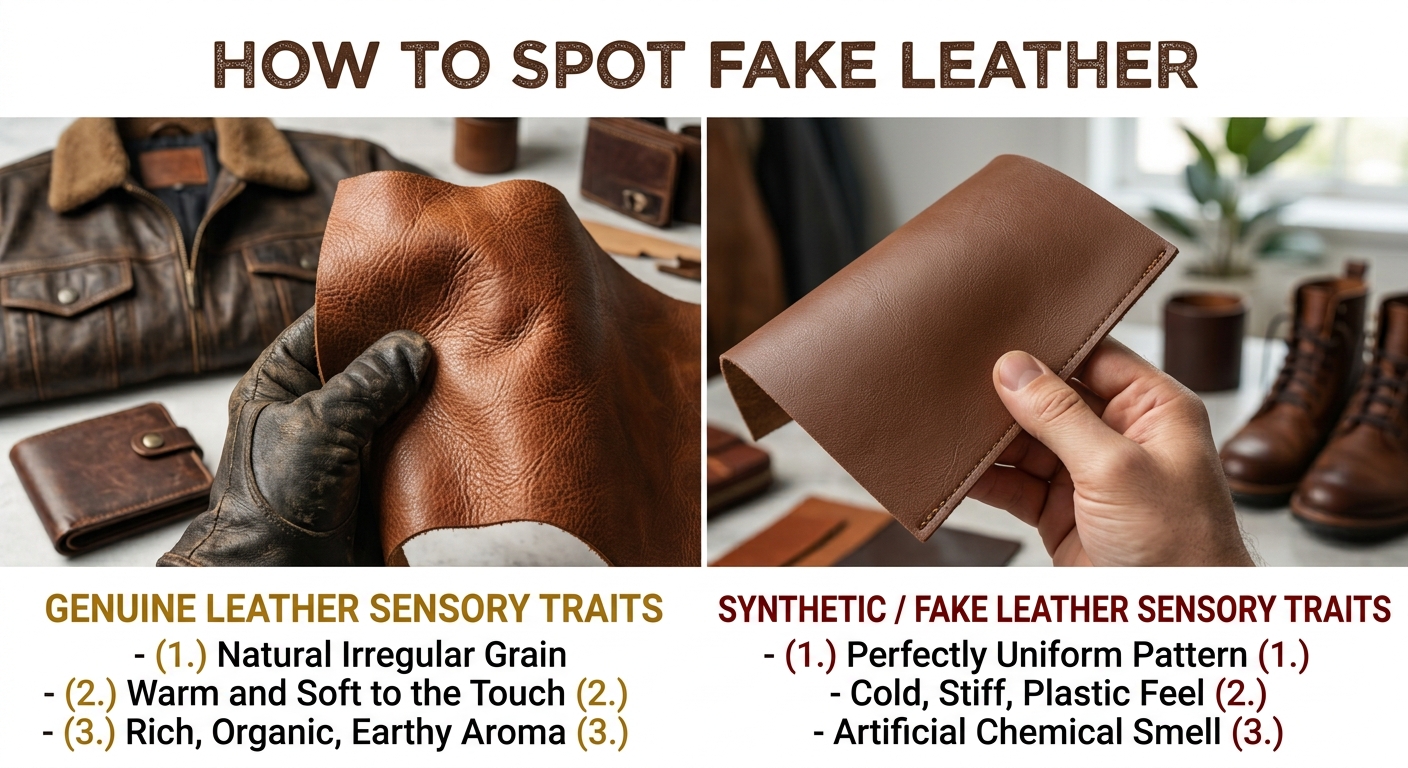
Real leather comes from natural animal hides, meaning no two pieces are identical.
- Real Leather: Look for irregular pores, subtle wrinkles, unique grain patterns, and natural surface variations.
- Fake Leather: Features perfectly repeated, machine-embossed patterns with no organic flaws.
2. Feel the Texture and Flexibility
Press your thumb firmly into the material to test its elasticity.
- Real Leather: Soft, warm, and flexible. It wrinkles naturally under pressure and springs back into shape.
- Fake Leather: Cold, stiff, and feels like plastic. It retains rigid creases or stress marks when folded.
3. Take the Smell Test
Scent is one of the quickest ways to distinguish real hide from synthetic materials.
- Real Leather: Has a rich, earthy, distinct organic aroma.
- Fake Leather: Emits a strong chemical, plastic, or vinyl-like smell.
4. Inspect the Unfinished Edges
Check the seams or cut edges of the product.
- Real Leather: Shows rough, fibrous layers and natural suede-like strands.
- Fake Leather: Exhibits smooth, clean cuts with visible fabric backing, foam, or plastic coatings.
5. Perform the Water Drop Test
Note: Only perform this on untreated or semi-aniline leather.
- Real Leather: Absorbs a tiny drop of water within a few seconds, temporarily darkening the spot before drying naturally.
- Fake Leather: Water beads up on top and rolls off completely.
6. Look at the Backing Material
If you can view the reverse side of the material:
- Real Leather: Has a natural, fibrous, suede-like texture.
- Fake Leather: Reveals a woven fabric mesh or synthetic backing layer.
7. Know Your Leather Grades
Not all real leather offers the same quality. Understand these common grade designations:
- Full-Grain Leather: The absolute highest grade. Uses the full hide layer, retains natural characteristics, and develops a beautiful patina over time.
- Top-Grain Leather: The second-highest grade. Slightly sanded to remove surface imperfections while retaining strength and flex.
- Genuine Leather: Lower-grade leather made from the remaining layers of hide. Still real, but heavily processed and less durable than top-grain.
- Bonded Leather: Shredded leather scraps bonded together with adhesives. Offers poor durability compared to solid hide layers.
8. Decode Confusing Marketing Labels
Brands often use deceptive terminology to obscure synthetic compositions.
- Avoid These (Synthetic): PU Leather, Vegan Leather, Leatherette, Leather Feel, Faux Leather, Microfiber Leather.
- Look for These (Authentic): 100% Full-Grain Leather, Top-Grain Leather, Vegetable-Tanned Leather.
9. Check the Price Point
While high prices don’t always guarantee real leather, suspiciously low prices for “leather” products are a definitive red flag. Authentic tanning and manufacturing processes require quality materials and craftsmanship that reflect in the cost.
10. Buy From Transparent Retailers
The easiest way to ensure authenticity is to buy from brands with clear manufacturing standards. At Reizvol, we provide full transparency across all product descriptions, clearly stating hide origin, leather grade, and care guidelines for every item.
Debunking Common Leather Myths
- Myth 1: “Vegan Leather” is an eco-friendly real leather alternative.
- Fact: Most vegan leathers are made from Polyurethane (PU) or Polyvinyl Chloride (PVC)—plastics that emit environmental pollutants and do not biodegrade easily.
- Myth 2: “Genuine Leather” means top-tier quality.
- Fact: “Genuine Leather” is an industry term for a specific, lower-tier hide layer. It is real leather, but significantly weaker than top-grain or full-grain choices.
- Myth 3: Real leather never scratches or creases.
- Fact: High-quality, unsealed leathers scratch and crease naturally, which contributes to their unique patina over time.
Quick Leather Checklist Before Buying
Before completing a purchase, run through this quick checklist:
- [ ] Does the product grain look naturally irregular?
- [ ] Is there a distinct organic hide smell rather than a plastic aroma?
- [ ] Are the seams or edges fibrous rather than backed by fabric mesh?
- [ ] Does the label clearly state “Full-Grain” or “Top-Grain” leather?
Why Choose Reizvol?
At Reizvol, transparency and craftsmanship guide our entire design process. Every product is crafted using authentic, high-grade leather selected for maximum durability, breathability, and long-term value. When you invest in Reizvol, you choose leather goods built to age beautifully alongside you.
Frequently Asked Questions (FAQ)
How can I tell if leather is real right away?
The fastest methods are testing the smell (earthy vs. plastic), inspecting the grain for natural imperfections, and checking the product label for specific grades like full-grain or top-grain.
Is PU leather real leather?
No. PU (polyurethane) leather is a 100% synthetic material created to mimic the look of genuine hide. It lacks the durability, breathability, and aging characteristics of authentic leather.
What is the highest quality leather grade available?
Full-grain leather is the highest quality. It utilizes the entire top hide layer, offering maximum durability and the ability to develop a natural patina over time.
Why does fake leather peel and crack?
Synthetic leather consists of a plastic coating applied over fabric. Over time, exposure to sunlight, body oils, and friction breaks down the synthetic polymers, causing the surface layer to crack and separate.